This is a quiz database made by a student. While the class notes from the University of Calgary have been used as reference materials, this website has no affiliation to the University or the instructors involved. Please do not associate the information on this site with the University of Calgary.
If you get an answer wrong, please keep selecting other options to reveal the correct answer and explanation (if it is available). You should be able to score at least 95% (if not, go back and study your notes) because the scoring algorithm is: # right answers – # of attempts / # of questions answered * 100. So even in the middle of the quiz, you will be able to grade yourself on how well you did up that point without completing the entire quiz.
Go to: Midterm I | Final
Geology (GLGY 491-UCAL) Midterm II
Congratulations - you have completed Geology (GLGY 491-UCAL) Midterm II.
You scored %%SCORE%% out of %%TOTAL%%.
Your performance has been rated as %%RATING%%
Question 1 |
A | Mineralization |
B | Recrystallization |
C | Impressions |
D | Carbonizations |
Question 2 |
A | I. Pedicle valve II. Brachial valve |
B | I. umbo II. the beak |
C | I. the beak II. umbo |
D | I. Brachial valve II. Pedicle valve |
Question 3 |
A | Building the structures to hold the corals to the seabed (skeleton). |
B | Processing water to extract dissolved oxygen (respiratory). |
C | Distribution of organic materials throughout the body structure (circulatory). |
D | Discharging poison into a pray (feeding). |
Question 4 |
A | Organocalcitic |
B | Aragonitic |
C | Siliceous |
D | Organophosphatic |
E | Calcitic |
Question 5 |
A | Parvancorina |
B | Tribrachidium |
C | Charnia |
D | Dickinsonia |
Question 6 |
A | False |
B | True |
Question 7 |
A | Eoarchean |
B | Neoarchean |
C | Hadean |
D | Paleoproterozoic |
E | Paleozoic |
Question 8 |
A | Temperature difference between hot Earth and the cold space. |
B | Convection currents and magmatic processes. |
C | Mixing of gases from two independent sources. |
D | Precipitation of minerals due to extraction of water. |
Question 9 |
A | Stromatolites |
B | Quartz |
C | Calcite - Dolomite |
D | Zircon |
Question 10 |
A | Oxygen-depleted zone |
B | Stromatolite mass |
C | Growth surface |
D | Undermat |
Question 11 |
A | 4.0 billion years after |
B | 0.8 billion years after |
C | 1.5 billion years after |
D | 0.2 billion years after |
Question 12 |
A | Neoarchean |
B | Mesoproterozoic |
C | Neoproterozoic |
D | Cambrian |
Question 13 |
A | True |
B | False |
Question 14 |
A | Order Tabulata |
B | Order Septalata |
C | Order Scleractinia |
D | Order Rugosa |
Question 15 |
A | Proterozoic |
B | Neoarchean |
C | Phanerozoic |
D | Archean |
E | Hadean |
Question 16 |
A | ~ 2.7 billion years |
B | ~ 3.8 billion years |
C | ~ 3.2 billion years |
D | ~ 4.5 billion years |
Question 17 |
A | Banded Iron Fm. |
B | Stromato Fm. |
C | Fig Tree Fm. |
D | Gunflint Fm. |
Question 18 |
A | Charnia |
B | Parvancorina |
C | Tribrachidium |
D | Dickinsonia |
Question 19 |
A | True |
B | False |
Question 20 |
A | Productida |
B | Linguliformea |
C | Pentamerida |
D | Orthida |
Question 21 |
A | True |
B | False |
Question 22 |
A | I. six (6) II. Oxygen-depleted zone |
B | I. four (4) II. Undermat |
C | I. four (4) II. Oxygen-depleted zone |
D | I. four (4) II. Undermat |
E | I. four (4) II. Stromatolite mass |
Question 23 |
A | Ordovician |
B | Permian |
C | Cambrian |
D | Cretaceous |
Question 24 |
A | Volcanic lava |
B | Dolomite based minerals |
C | Graphite |
D | Calcite based minerals |
Question 25 |
A | Cambrian |
B | Devonian |
C | Cretaceous |
D | Ordovician |
Question 26 |
A | 180 |
B | 45 |
C | 90 |
D | 60 |
Question 27 |
A | zooarium |
B | zooecia |
C | zooid |
D | zooarozoida |
Question 28 |
A | True |
B | False, because they can be either punctate or impunctate. |
C | False, because they always have impunctate shells. |
D | False, because they always have punctate shells. |
Question 29 |
A | Cloudina |
B | Bonata |
C | Spriggina |
D | Terebratula |
Question 30 |
A | During Frasnian/Famennian crisis |
B | During Permian/Triassic crisis |
C | During Ordovician/Silurian crisis |
D | During Cretaceous/Paleogene crisis |
Question 31 |
A | True |
B | False because they are both reef-builders and non-reefbuilders. |
C | False, because they are reef-builders. |
Question 32 |
A | False |
B | True |
Question 33 |
A | Subphylum Craniiformea |
B | Order Strophomenida |
C | Order Pentamerida |
D | Order Orthida |
Question 34 |
A | I. cardinal II. counter |
B | I. lateral II. counter lateral |
C | I. counter II. cardinal |
D | I. counter lateral II. lateral |
Question 35 |
Tabulata, Rugosa, Scleractinia
A | Scleractinia, because we can also find them today. |
B | Rugosa, because we also can find them today. |
C | Tabulata, because we can also find them today. |
D | Tabulata, because it is the only one that forms corals. |
Question 36 |
A | Archean/Proterozoic boundary |
B | Lower Cambrian |
C | Archean |
D | Neoarchean |
E | Upper Cambrian |
Question 37 |
A | Shelly organisms |
B | Invertebrates organisms |
C | Eukaryotic organisms |
D | Prokaryotic organisms |
Question 38 |
A | False |
B | True |
Question 39 |
A | False |
B | True |
Question 40 |
A | Isua Fm. |
B | Delta calcitic unit. |
C | Banded Iron Fm. |
D | Apex Chert unit. |
Question 41 |
A | Rhynchonellida |
B | Pentamerida |
C | Orthida |
D | Productida |
E | Strophomenida |
Question 42 |
A | They are highly concentrated with cyanobacteria. |
B | They are solitary corals and lives in low energy environments. |
C | They are a Suborder of Order Rugosa. |
D | They are reef-builders and are colonial. |
Question 43 |
A | I. Phoronida II. Bryozoa |
B | I. Brachiopoda II. Enthoprota |
C | I. Phoronida II. Enthoprota |
D | I. Brachiopoda II. Bryozoa |
Question 44 |
A | Atrypida Hint: This is near the boundary NOT at the. |
B | Productida |
C | Pentamerida |
D | Orthida |
E | Terebratulida |
Question 45 |
A | True |
B | False |
Question 46 |
A | The crust of the Earth is not ductile enough to deform significantly to provide a record. |
B | Earth probably had less bombardments than any other planet. |
C | The plate tectonics may have destroyed the evidence. |
D | The oceanic water many have changed the landscape of Earth. |
Question 47 |
I. Lingulids
II. Spiriferids
III. Pentamerids
IV. Terebratulids
A | (oldest) I > IV> II > III (youngest) |
B | (oldest) I > III > II > IV (youngest) |
C | (oldest) I > II > IV > III (youngest) |
D | (oldest) IV > I > II > III (youngest) |
Question 48 |
A | Feeding |
B | Circulatory |
C | Defense/attack |
D | Movement |
Question 49 |
A | Crater rocks from Moon, Mercury and Mars |
B | Gunflint Formation from Ontario |
C | Isua Formation in SW Greenland Hint: Only traces of it found here; NOT strong evidence. |
D | Apex Chert from Western Australia |
Question 50 |
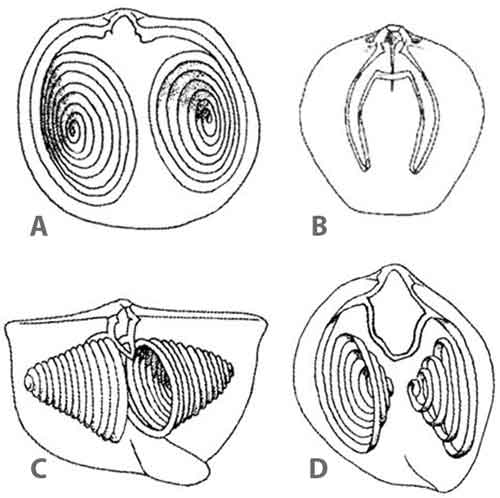
A | Atrypid |
B | Zygospirid |
C | Terebratulid |
D | Spiriferid |
Question 51 |
A | About 4.2 billion years. |
B | About 2.5 billion years. |
C | About 3.2 billion years. |
D | About 3.8 billion years. |
Question 52 |
A | Triassic to Recent |
B | Ordovician to Recent |
C | Ordovician to Permian |
D | Cambrian to Permian |
Question 53 |
A | lamellate |
B | autopore |
C | cystiphragm |
D | tabule |
Question 54 |
A | Zygospirid |
B | Atrypid |
C | Spiriferid |
D | Terebratulid |
Question 55 |
A | Order Tabulata |
B | Order Rugosa |
C | Order Scleractinia |
D | Order Octocoralia |
Question 56 |
A | Neoproterozoic |
B | Cambrian |
C | Jurassic |
D | Ordovician |
Question 57 |
A | The first type of fauna to process oxygen from atmosphere. |
B | Oldest known fossils were found in this formation. |
C | The earliest abundant shelly fauna that evolved on Earth. |
D | The first organisms to release oxygen to the atmosphere. |
Question 58 |
A | Holoperiheral |
B | Sphereperipheral |
C | Hemiperipheral |
D | Mixoperipheral |
Question 59 |
A | True |
B | False |
Question 60 |
A | Huronipora |
B | Melanocyrillium |
C | Bangiomorpha |
D | Torridonophycus |
Question 61 |
A | Permian |
B | Ordovician |
C | Triassic |
D | Cretaceous |
Question 62 |
A | Terebratulida |
B | Strophomenida |
C | Productida |
D | Atrypida |
E | Rhynchonellida |
Question 63 |
A | False because they are known as cystiphragms. |
B | False because they are known as cups. |
C | True |
D | False because they are known as plates. |
Question 64 |
I. Stromatolites numerical reduction
II. Apex Chert unit
III. Gunflint Formation
IV. Fig Tree Formation
V. Isua Formation
VI. Shark Bay stromatolites
A | (oldest) VI > II > IV > III > I > V (youngest) |
B | (oldest) II > V > IV > III > I > VI (youngest) |
C | (oldest) VI > III > IV > II > I > V (youngest) |
D | (oldest) V > IV > II > I > III > VI (youngest) |
E | (oldest) V > II > IV > III > I > VI (youngest) |
Question 65 |
A | True |
B | False |
Question 66 |
I. Strophomenida
II. Productida
III. Orthida
IV. Rhynchonellida
V. Spiriferida
VI. Terebratulida
A | (oldest) III > V > IV > I > II > VI (youngest) |
B | (oldest) I > IV > III > V > II > VI (youngest) |
C | (oldest) I > IV > V > III > II > VI (youngest) |
D | (oldest) III > I > IV > V > II > VI (youngest) |
E | (oldest) I > V > III > IV > II > VI (youngest) |
Question 67 |
A | False |
B | True |
Question 68 |
A | False |
B | True |
Question 69 |
A | Stromatoporoids |
B | Cyanobacteria |
C | Rugose corals |
D | Dikinsonians |
Question 70 |
I. Triassic - Jurassic crisis
II. Cretaceous - Paleogene crisis
III. Ordovician - Silurian crisis
IV. Frasnian - Famennian crisis
V. Permian - Triassic crisis
A | (oldest) V > III > IV > II > I (youngest) |
B | (oldest) I > II > V > III > IV (youngest) |
C | (oldest) III > IV > V > I > II (youngest) |
D | (oldest) II > IV > V > III > I (youngest) |
Question 71 |
A | Impunctate shell |
B | Having a one large and one small shell. |
C | Pseudopunctate shell |
D | Punctate shell |
Question 72 |
A | Taleola |
B | Median septum |
C | Brachidium |
D | Cardinal |
E | Tabula |
Question 73 |
A | Upper Devonian |
B | Upper Ordovician |
C | Lower Cambrian |
D | Early Cretaceous |
Question 74 |
A | Spiriferid |
B | Zygospirid |
C | Atrypid |
D | Terebratulid |
Question 75 |
- Strophomenida
- Productida
- Orthida
- Pentamerida
- Rhynchonellida
- Atrypida
- Spiriferida
- Terebratulida
A | Atrypida, Productida and Pentamerida |
B | Orthida, Spiriferida and Terebratulida |
C | Orthida and Terebratulida |
D | Atrypida and Productida |
E | Spiriferida and Terebratulida |
Question 76 |
A | Paleozoic |
B | Neoproterozoic |
C | Mesoarchean |
D | Ediacaran |
E | Cambrian |
Question 77 |
A | Fig Tree Formation |
B | Isua Formation |
C | Apex Chert unit |
D | Shark Bay stromatolites |
E | Gunflint Formation |
Question 78 |
A | Order Heterocoralia |
B | Order Rugosa |
C | Order Scleractinia |
D | Order Tabulata |
Question 79 |
A | True |
B | False |
Question 80 |
A | False |
B | True |
Question 81 |
A | Jurassic |
B | Permian |
C | Cambrian |
D | Ordovician |
Question 82 |
A | Gunflint Formation. |
B | Isua Formation. |
C | Apex Chert unit |
D | Fig Tree Formation |
Question 83 |
A | Class Anthozoa |
B | Class Cinclaire |
C | Class Scyphozoa |
D | Class Hydrozoa |
Question 84 |
A | five |
B | six |
C | two |
D | three |
Question 85 |
A | 2 |
B | 4 |
C | 3 |
D | 5 |
Question 86 |
A | Charnia |
B | Spriggina |
C | Parvancorina |
D | Tribrachidium |
Question 87 |
A | False |
B | True |
Question 88 |
A | ~ 430 million years ago |
B | ~ 400 million years ago |
C | ~ 460 million years ago |
D | ~ 500 million years ago |
E | ~ 510 million years ago |
Question 89 |
A | All Bryozoans have digestive and reproductive systems. |
B | All Bryozoans are invertebrates. |
C | All Bryozoans are asexual organisms. |
D | All Bryozoans are colonial. |
Question 90 |
A | ~ 510 million years ago |
B | ~ 585 million years ago |
C | ~ 470 million years ago |
D | ~ 500 million years ago |
E | ~ 410 million years ago |
Question 91 |
A | Carboniferous and Permian |
B | Cambrian and Ordovician |
C | Cretaceous and Paleogene |
D | Jurassic and Cretaceous |
Question 92 |
A | Lungs |
B | Specialized tissues |
C | Specialized organs |
D | Primitive organs |
Question 93 |
A | Zygospirid |
B | Terebratulid |
C | Spiriferid |
D | Atrypid |
Question 94 |
A | Hemipheripheral |
B | Radiocircular |
C | Holoperipheral |
D | Sphericalcircular |
E | Mixoperipheral |
Question 95 |
A | False |
B | True |
Question 96 |
A | 4 |
B | 2 |
C | 1 |
D | 3 |
← |
List |
→ |
| 1 | 2 | 3 | 4 | 5 |
| 6 | 7 | 8 | 9 | 10 |
| 11 | 12 | 13 | 14 | 15 |
| 16 | 17 | 18 | 19 | 20 |
| 21 | 22 | 23 | 24 | 25 |
| 26 | 27 | 28 | 29 | 30 |
| 31 | 32 | 33 | 34 | 35 |
| 36 | 37 | 38 | 39 | 40 |
| 41 | 42 | 43 | 44 | 45 |
| 46 | 47 | 48 | 49 | 50 |
| 51 | 52 | 53 | 54 | 55 |
| 56 | 57 | 58 | 59 | 60 |
| 61 | 62 | 63 | 64 | 65 |
| 66 | 67 | 68 | 69 | 70 |
| 71 | 72 | 73 | 74 | 75 |
| 76 | 77 | 78 | 79 | 80 |
| 81 | 82 | 83 | 84 | 85 |
| 86 | 87 | 88 | 89 | 90 |
| 91 | 92 | 93 | 94 | 95 |
| 96 | End |
You may download this exam as a PDF file here.
Credits: Based on the excellent class notes provided by, Dr. Marius (Dan) Georgescu during Fall 2013.
FAQ | Report an Error
In case in you have missed the additional support materials, please visit the main Exams & Resources page and check under GLGY 491.