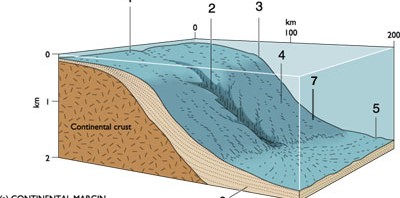
Disclaimer: While every reasonable effort is made to ensure that the information provided is accurate, no guarantees for the currency or accuracy of information are made. It takes several proof readings and rewrites to bring the quiz to an exceptional level. If you find an error, please contact me as soon as possible. Please indicate the question ID-Number or description because server may randomize the questions and answers.
Go to: Midterm I | Midtrem II
Geology (GLGY 381-UCAL) Final Exam
Congratulations - you have completed Geology (GLGY 381-UCAL) Final Exam.
You scored %%SCORE%% out of %%TOTAL%%. With incorrect multiple attempts your score is %%PERCENTAGE%%
Your performance has been rated as %%RATING%%
Question 1 |
A | Second-order |
B | It is based on the type of tectonic and basinal setting. |
C | First-order |
D | Third-order |
Question 2 |
A | clockwise direction. |
B | upwards at 90 degrees to the rotational face. |
C | downwards at 90 degrees to the rotational face. |
D | counter clockwise direction. (if you take to a bloody British, it will bloody anti-clockwise 🙂 |
Question 3 |
A | A. low B. high |
B | A. high B. low |
C | A. Non-oscillating B. Oscillating |
D | A. Oscillating B. Non-oscillating |
Question 4 |
A | more denser |
B | more granitic |
C | more basaltic |
D | more mafic |
Question 5 |
A | forced regression |
B | regression |
C | transgression |
D | regression and forced regression |
E | regression and transgression |
Question 6 |
A | Fan deltas |
B | None of the answers are correct |
C | Tide-dominated deltas |
D | Wave-dominated deltas |
Question 7 |
A | beds |
B | members |
C | formations |
D | supergroups |
E | groups |
Question 8 |
A | photic zone. |
B | active zone. |
C | coral reef zone. |
D | passive zone. |
Question 9 |
A | Velocity of rivers |
B | Climate and weather |
C | None of the answers are correct. |
D | Tectonics such as subsidence and uplift |
E | Sediment load |
Question 10 |
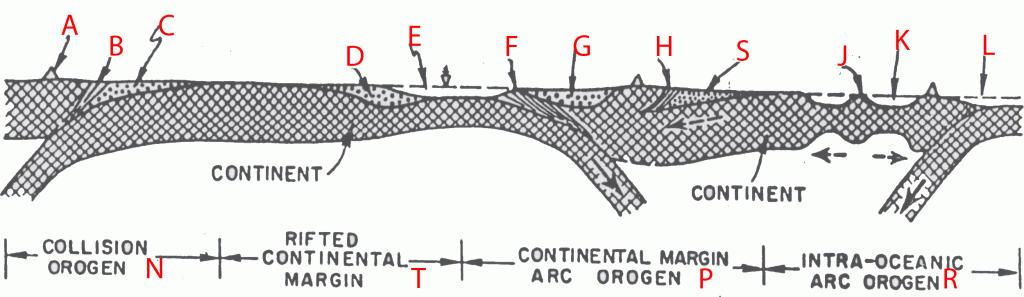
In which area would you expect to find the passive margin (choose from red letters)? (ID-SSF-41)
A | H |
B | R |
C | N |
D | T |
E | P |
Question 11 |
A | passive margins. |
B | active margins. |
C | margins with high slope basements. |
D | volcanic regions. |
Question 12 |
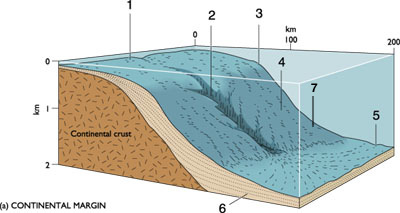 Diagram is copyrighted to pima.edu
A | 5 |
B | 2 |
C | 4 |
D | 1 |
E | 3 |
Question 13 |
A | oceanic shelf. |
B | continental shelf. |
C | the mid ocean ridge. |
D | continental boundary. |
E | the basin. |
Question 14 |
A | Lowstand |
B | Highstand |
C | Warm and wet seasons |
D | Retrogradation |
Question 15 |
A | Gravel dominated deposits |
B | Extremely low subsidence |
C | Extremely high subsidence |
D | Mud and silt dominated deposits |
E | Sand dominated deposits |
Question 16 |
A | They only occurred in the per-Cambrian and no longer observed in modern day environments. |
B | They often result in turbidites deposition. |
C | They carry sediments on top of sea waters for a long distances out into the ocean before settling to the bottom. |
D | They are typically associated with low density sediment loads. |
E | They drive the forces needed for delta formation. |
Question 17 |
A | The pressure on both sides of the continental or oceanic boundaries must be at equilibrium. |
B | The forces within the crust should exceed the forced applied on the crust by the load resulting flexure. |
C | I have no clue what the hell you are talking about. I hate applied principles of geology. Hint: Since you have pick this one, I suggest that you click and open the renaming choices just to read what it was.....? |
D | The force of the load due to gravity must be large enough to overcome the forces within the crust resulting flexure. |
Question 18 |
A | There is no effect because the carbonate productivity is independent of terrigenous clastic supply. |
B | At first terrigenous clastic supply will rapidly increase the carbonate productivity, but in the long run it will create chemical barriers reducing carbonate productivity. |
C | Increased terrigenous clastic supply reduces carbonate productivity. |
D | At first it will rapidly decrease the carbonate productivity, but in the long run it will increase the carbonate productivity as terrigenous clastic supply will introduce essential chemical components to the system. |
Question 19 |
A | No |
B | Yes |
Question 20 |
A | Muddy deposits |
B | Coastal plain deposits |
C | Sandy deposits |
D | Clastic deposits |
Question 21 |
A | counter clockwise direction. (if you take to a bloody British, it will bloody anti-clockwise 🙂 |
B | upwards at 90 degrees to the rotational face. |
C | clockwise direction. |
D | downwards at 90 degrees to the rotational face. |
Question 22 |
A | foredeep |
B | wedgetop |
C | backbulge |
D | forebulge |
Question 23 |
A | Dominant sandy deposits at the base |
B | Fining upward |
C | Dominant muddy deposits in distal regions |
D | Coarsening upward |
Question 24 |
What type of collision occur at the area marked with F? (ID-SSF-39)
A | Subduction Complex |
B | Interarc Basin |
C | Magmatic Arc |
D | Trench |
E | Rifted Margin Prism |
Question 25 |
A | Long term variations in the volume of glaciers which result in global sea level changes. |
B | Long term variations in global temperatures that is caused by natural cycles of the Sun. |
C | Long term variations in the orbit of the Earth which result in changes in climate. |
D | Long term variations in the rate of sea floor spreading and subduction which result in global sea-level changes. |
E | Long term variation in atmospheric conditions which results in global changes in sedimentary processes. |
Question 26 |
A | Transgression |
B | Forced regression |
C | Rate of chemical weathering |
D | Global tectonics |
E | Regression |
Question 27 |
A | True |
B | False because it can preserve only up to few thousands of years because tidal currents disturb the depositional process. |
C | False because it can only preserve up to about half a million years. |
Question 28 |
A | True |
B | Flase |
Question 29 |
A | on the volcanic arc |
B | near mid ocean ridges(MOR) |
C | on the basin floor fan. |
D | near nonconformities |
E | near paraconformities |
Question 30 |
A | A. increases B. increases |
B | A. decreases B. decreases |
C | A. increases B. decreases |
D | A. decreases B. increases |
Question 31 |
A | torpedo rise. |
B | super surge. |
C | super elevation. Hint: READ THE QUESTION CAREFULLY. |
D | storm surge. |
Question 32 |
A | Topset |
B | Distalset |
C | Bottomset |
D | Foreset |
Question 33 |
A | Rate of chemical weathering |
B | Relative base level |
C | Rifting mechanisms |
D | Eustasy |
E | Global tectonics |
Question 34 |
Diagram is copyrighted to pima.edu
A | 7 |
B | 4 |
C | 1 |
D | 2 |
E | 3 |
Question 35 |
A | True |
B | False |
Question 36 |
A | Progradation |
B | Transgression |
C | Rising sea level |
D | Increase in accommodation space |
E | Regression Hint: Close, but this is not the right term! |
Question 37 |
A | paraconformity |
B | disconformity |
C | angular unconformity. |
D | a conformity. |
E | a hiatus. |
Question 38 |
A | Accommodation space always will be deceased significantly. |
B | Sediments will be mostly filled in the continental shelf with very little to no sed deposition on the basin. |
C | Sediments will be mostly filled in the basin bypassing the deposition process on the continental shelf. |
D | Accommodation space will be moved towards the shoreline. |
Question 39 |
A | When analyzing data collected from a large region. |
B | When dealing with areas that is difficult to access. |
C | When analyzing data collected in a small region. |
D | When analyzing fossils and chemical composition (carbon) to date formations. |
Question 40 |
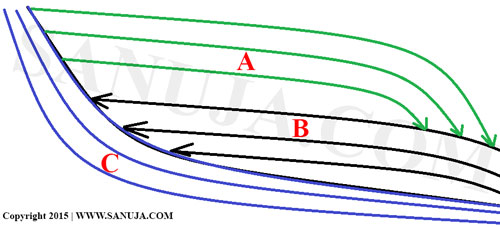
What letter on the following cartoon represent the toplap-downlap sequence? (yes, it is a two different things, so watch out!) (ID-SSF-44)
A | A and C |
B | B and C |
C | A |
D | C |
E | A and B |
F | B |
Question 41 |
A | Nonconformity |
B | Hiatus |
C | Angular unconformity |
D | Disconformity |
E | Paraconformity |
Question 42 |
A | abyssal plains.. |
B | paraconformities. |
C | basins. |
D | disconformities. |
Question 43 |
A | progradation |
B | retogradation |
C | aggradation |
D | transgredation |
Question 44 |
A | The line between the lateral contact of two sets of widely different strata. |
B | An unexplained nonconformity. |
C | A sudden increase of deposition in a specific window of geologic time. |
D | A discontinuity in the age of strata due to lack of deposition. |
Question 45 |
A | Discharge and relief are associated with hinterland and accommodation and slope is associated with basin. |
B | Discharge, subsidence and accommodation are associated with hinterland and subsidence is associated with basin. |
C | Discharge and relief are associated with hinterland and accommodation and subsidence are associated with basin. |
D | Discharge and subsidence are associated with hinterland and accommodation is associated with basin. |
E | Discharge, relief and subsidence are associated with hinterland and accommodation is associated with basin. |
Question 46 |
A | near the wave base |
B | near the mid ocean ridge |
C | inner the inner shelf |
D | near the shore line |
Question 47 |
If you were to indicate the boundary between the Indian-Asian crust, where would it be (choose from red letters)? (ID-SSF-40)
A | F |
B | A |
C | L |
D | B |
E | D |
Question 48 |
What type of collision can occur at the area marked with N? (ID-SSF-38)
A | Continent-Continent Collision |
B | Passive Margin Collision |
C | Active Margin Collision |
D | Continent-Ocean Collision |
E | Ocean-Ocean Collision |
Question 49 |
A | True |
B | False |
Question 50 |
A | subduction and trenches |
B | continental volcanoes |
C | hot spots |
D | sea-floor spreading and mid-ocean ridges |
E | transform faulting |
Question 51 |
A | The first term describes the seawards movement of the shoreline and the second term describes the landwards movement of the shoreline. |
B | The first term describes the landwards movement of the shoreline and the second term describes the seawards movement of the shoreline. |
C | They are the same; therefore the question is wrong. |
D | The first term is used in depositional descriptions and the second term is used in fluvial descriptions. |
Question 52 |
Diagram is copyrighted to pima.edu
A | 5 |
B | 3 |
C | 4 |
D | 6 |
E | 7 |
Question 53 |
A | wedgetop |
B | backbulge |
C | suckdeep |
D | forebulge |
E | foredeep |
Question 54 |
A | False |
B | True |
Question 55 |
A | wedgetop |
B | basin |
C | forebulge |
D | channel |
E | backbuldge |
F | foredeep |
G | foreland |
Question 56 |
A | I. fining upwards II. fining upwards III. coarsening upwards |
B | I. fining upwards II. coarsening upwards III. fining upwards |
C | I. fining upwards II. coarsening upwards III. coarsening upwards |
D | I. coarsening upwards II. fining upwards III. fining upwards |
E | I. fining upwards II. fining upwards III. fining upwards |
Question 57 |
A | onlap |
B | toplap |
C | erosional surface |
D | downlap |
Question 58 |
A | False |
B | True |
Question 59 |
The Magmatic Arc is represented by... (choose from red letters) (ID-SSF-42)
A | C |
B | A |
C | D |
D | B |
E | E |
Question 60 |
A | Decrease in relative sea level and uplift occurring at the same time. |
B | Increase in relative sea level and increased in sediment input at the same time. |
C | Increase in relative sea level and increase in subsidence the same time. |
D | Decrease in relative sea level and increased in sediment input at the same time. |
E | Increase in relative sea level and uplift occurring at the same time. |
Question 61 |
A | A. Rising inflection point (RIP)
B. highstand |
B | A. Highstand
B. rising inflection point (RIP) |
C | A. Highstand
B. rising inflection point (RIP) |
D | A. Highstand
B. falling inflection point (FIP) |
E | A. Lowstand
B. falling inflection point (FIP) |
Question 62 |
Diagram is copyrighted to pima.edu
A | 2 |
B | 4 |
C | 5 |
D | 3 |
E | 1 |
Question 63 |
A | Fall in relative sea-level and movement of the shoreline landwards. |
B | None of the answers listed here are correct. |
C | Rise in relative sea-level and movement of the shoreline landwards. |
D | Rise in relative sea-level and movement of the shoreline seawards. |
E | Fall in relative sea-level and movement of the shoreline seawards. |
Question 64 |
A | rise in sea level |
B | sudden decrease in regional sed load. |
C | sudden increase in regional sed load. |
D | lowstand |
E | highstand |
Question 65 |
A | theoretical |
B | analytical |
C | spatial |
D | temporal |
E | practical |
Question 66 |
A | Retogradational |
B | Progradational |
C | Aggradational |
D | Transgressional |
Question 67 |
A | Global sea level will be increase as the new oceanic crust takes up space in basins. |
B | Global sea level will be decrease as new oceanic crust is formed due to spreading. |
C | Sediment influx will be significantly decreased as deposited sediments within the accommodation space is used up to produce new oceanic crust. |
D | Active spreading ridges would have no impact on either sediment influx or global sea levels because this activity will be balanced through subduction. |
E | Sediment influx will be significantly increased as continental crust is pushed further upwards resulting greater erosion. |
Question 68 |
A | True |
B | False |
← |
List |
→ |
| 1 | 2 | 3 | 4 | 5 |
| 6 | 7 | 8 | 9 | 10 |
| 11 | 12 | 13 | 14 | 15 |
| 16 | 17 | 18 | 19 | 20 |
| 21 | 22 | 23 | 24 | 25 |
| 26 | 27 | 28 | 29 | 30 |
| 31 | 32 | 33 | 34 | 35 |
| 36 | 37 | 38 | 39 | 40 |
| 41 | 42 | 43 | 44 | 45 |
| 46 | 47 | 48 | 49 | 50 |
| 51 | 52 | 53 | 54 | 55 |
| 56 | 57 | 58 | 59 | 60 |
| 61 | 62 | 63 | 64 | 65 |
| 66 | 67 | 68 | End |
Credits: Based on the excellent class notes provided by, Dr. Melissa Giovanni during Fall 2012.
FAQ | Report an Error